
 EN
EN
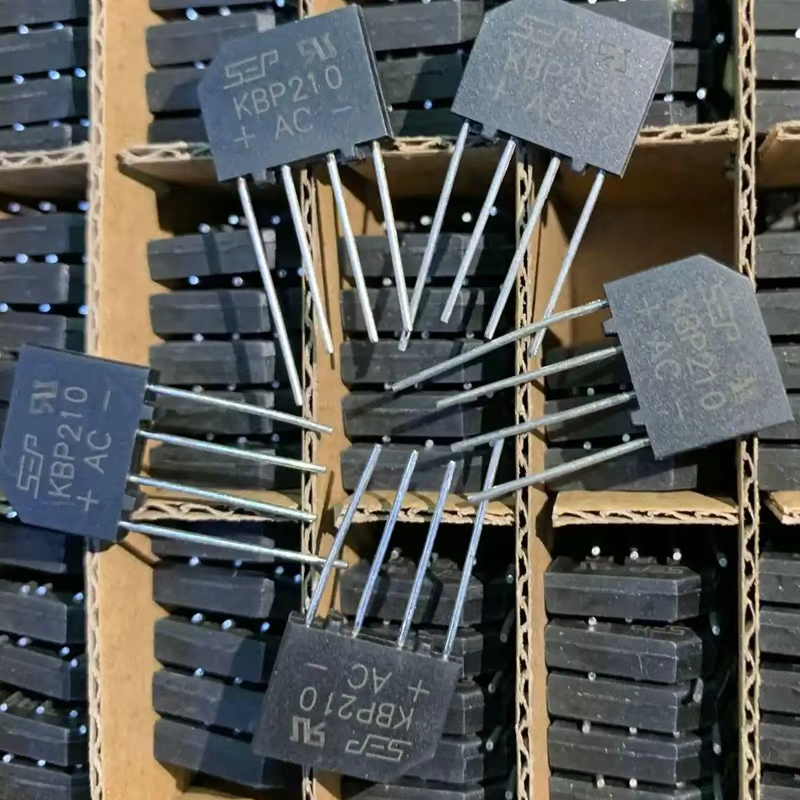
How Bridge Rectifiers Enable Efficient AC to DC Conversion
What is a bridge rectifier and how it converts AC to DC
The bridge rectifier works as an electronic circuit to turn alternating current or AC into something closer to direct current DC, though it still has those pulses in there. It uses four diodes set up in what looks like a bridge shape when drawn out on paper. Now compare that to half wave rectifiers that basically throw away half the electricity coming through. The bridge version actually handles both sides of the AC signal, so we get about twice as much power converted compared to those simpler designs. What happens here is pretty clever really. Those negative parts of the electricity get flipped around by how the diodes conduct together, making sure everything flows one way only. This matters a lot because most gadgets need steady power direction to work properly, think about charging phones or running LED lights for example.
Full-wave rectification using four-diode configuration
The four-diode bridge enables full-wave rectification via two complementary conduction paths:
- Positive half-cycle: Diodes D1 and D2 conduct, routing current through the load
- Negative half-cycle: Diodes D3 and D4 activate, maintaining consistent output polarity
As detailed in studies on rectifier efficiency, this method cuts ripple voltage by 50% compared to half-wave systems and achieves 81–85% efficiency at standard 60 Hz. The resulting doubled output frequency (120 Hz) also simplifies downstream filtering in power supplies.
Core components of a bridge rectifier circuit
Three key elements determine performance:
- Diodes: Four semiconductor devices (typically silicon) enabling bidirectional-to-unidirectional conversion
- Transformer: Optional for voltage scaling
- Load: Impedance affects ripple magnitude and overall efficiency
Eliminating center-tapped transformers reduces component cost by 15–20% in low-voltage applications while preserving compatibility with diverse AC inputs.
Bridge Rectifier Configurations: Single-Phase vs. Three-Phase Designs
Single-Phase Bridge Rectifier: Structure and Operation
The single phase bridge rectifier setup actually relies on four diodes arranged in what looks like a loop to turn alternating current into direct current. When the electricity wave is going up, two of those diodes let current pass through them. Then when the wave flips direction, the other two take over so the current keeps flowing in one direction only. According to that article on GeeksforGeeks about bridge rectifiers, this full wave method gives us much cleaner DC power compared to half wave options while losing very little voltage along the way. The design isn't complicated at all which is why we see these circuits everywhere from phone chargers to those LED light controllers people install around their homes nowadays.
Three-Phase Bridge Rectifiers for Industrial Applications
Industrial systems that require high power typically employ three phase bridge rectifiers containing six diodes to handle those three AC waveforms that are offset by 120 degrees each. What this configuration does is produce DC output with just around 4.2% voltage ripple. That's way better than what we see from half wave designs which can have nearly 48% ripple. The JAST Power folks mention in their guide on industrial rectifiers that these types of rectifiers hit efficiencies as high as 98% when used in things like motor drives and CNC machinery because they cut down on conduction losses so much. And since they work with input voltages ranging from 400 to 690 volts, they become essential components in renewable energy inverters and all sorts of heavy duty manufacturing gear where stable power conversion is absolutely necessary.
Full-Wave vs. Half-Wave Rectification: Performance Comparison
Full wave bridge rectifiers beat half wave ones because they work with both sides of the AC power cycle. This means twice as many pulses per second and much less voltage fluctuation in the output. According to research published last year by IEEE, these full wave setups hit around 90 percent efficiency while their half wave counterparts only manage about 40%. Another big plus is that full wave doesn't require those special center tapped transformers anymore. That cuts manufacturing costs by roughly two dollars and ten cents each when making them in bulk. Still, there are situations where half wave makes sense. Many basic sensor applications and simple control circuits don't need all that extra efficiency. For budget conscious projects where getting something working quickly matters more than squeezing every last drop of performance, half wave remains a practical choice despite its limitations.
Key Performance Metrics: Efficiency, Ripple, and Diode Ratings
Conversion Efficiency of Bridge Rectifiers
Modern bridge rectifiers achieve 94–97% efficiency in full-wave conversion, with primary losses stemming from diode forward voltage drops (0.7V per silicon diode). A 2024 power electronics study showed that replacing silicon with Schottky diodes (0.3V drop) reduces conduction losses by 42% at 12V output levels, enhancing overall system efficiency.
Understanding Ripple Factor, Ripple Voltage, and Frequency
When we talk about full wave rectifiers, they generate a ripple frequency around 100 Hz for standard 50 Hz AC power systems, or 120 Hz if working with 60 Hz systems. This means we generally need smaller filter capacitors compared to what's required for half wave rectifiers. Now, the ripple factor basically measures how much AC ripple remains in relation to the DC output voltage. This value changes depending on what kind of load is connected and how good the filtering circuit is. For most practical purposes, someone designing these circuits would find that a 1000 microfarad capacitor works pretty well to keep the ripple below 5 percent when dealing with loads around 500 milliamps. Of course there are exceptions based on specific requirements, but this gives a good starting point for many applications.
Peak Inverse Voltage (PIV) and Its Role in Diode Selection
For proper function, every diode needs to handle what's called peak inverse voltage matching the highest point of the AC input. Take a standard 120V RMS setup for instance, which actually peaks around 170 volts. Most engineers go with diodes rated for about 200V PIV just to be safe. When we look at data from SPICE simulations though, there's something interesting happening here. If components operate even 15% above their PIV rating, especially when things heat up to around 85 degrees Celsius, failures jump dramatically somewhere near triple what they normally would be. This is why many experienced technicians always err on the side of caution when picking out parts for these kinds of circuits.
Balancing Efficiency and Heat Dissipation in Design
Thermal management is crucial: every 10°C rise above 75°C degrades diode reliability by half due to increased power loss (P = I × V). Effective solutions include PCB copper pours and heat sinks with 2W/mm² thermal interfaces, which maintain junction temperatures below 110°C even under 5A continuous loads.
Smoothing Output with Capacitor Filtering in DC Power Supplies
Bridge rectifiers generate pulsating DC unsuitable for sensitive electronics. Capacitor filtering stabilizes this output, making it viable for modern digital and analog systems.
Role of Smoothing Capacitors in Reducing Ripple Voltage
Capacitors used for smoothing work by storing energy when voltage spikes occur and then releasing it when there's a drop, which helps fill those gaps in the electrical waveforms. According to various research in power electronics, these components can cut down on voltage fluctuations by around 70 percent. Take a standard 100 microfarad capacitor for example it might bring down voltage variations from about 15 volts to something below 5 volts in a regular 12 volt system when things are running normally. This kind of performance makes them essential parts in many electronic circuits where stable power delivery matters most.
Design Considerations for Effective Capacitor Filtering
Optimal filtering requires balancing three parameters:
- Load Current: Higher currents require larger capacitances (≈470µF) to sustain discharge periods
- Ripple Frequency: Full-wave outputs at higher frequencies allow smaller capacitors
- Voltage Rating: Capacitors should be rated for at least 1.5× the peak input voltage to avoid breakdown
As outlined in electrical engineering resources, the required capacitance follows:
C = \frac{I_{load}}{f \cdot V_{ripple}} where I is load current, f is ripple frequency, and V is allowable ripple voltage.
Impact of Capacitor Size on Output Stability and Response
Capacitor size directly influences ripple reduction and dynamic response. Test data illustrates this trade-off:
| Capacitance | Ripple Voltage | Rise Time (0-90%) |
|---|---|---|
| 47µF | 8.2V | 12ms |
| 220µF | 2.1V | 38ms |
| 1000µF | 0.5V | 165ms |
To balance performance, high-speed systems like SMPS often combine a 10µF ceramic capacitor with a 100µF electrolytic in parallel—achieving fast transient response and effective ripple suppression.
Real-World Applications and Advancements in Bridge Rectifier Technology
Bridge Rectifiers in Consumer Electronics and Power Adapters
Bridge rectifiers enable compact, efficient AC/DC conversion in smartphones, laptops, and IoT devices. Their full-wave architecture achieves 92–97% efficiency in modern adapters, minimizing energy waste. By eliminating bulky center-tapped transformers, they support 30% smaller footprints—critical for slim, fast-charging USB-PD compliant chargers.
Use in SMPS, Industrial Systems, and Mobile Chargers
SMPS systems need bridge rectifiers to handle that broad range of AC inputs from 90 to 264 volts. These power supplies show up everywhere these days, especially in big industrial motor drives and those backup power systems found in data centers. When we get into three phase versions, they really shine for heavy duty work. At around 50 kilowatts, these setups can hit almost perfect efficiency levels near 98%, and they manage to keep those pesky harmonics under control at less than 5%. The modular approach makes sense for solar and wind installations too. With active rectification technology, engineers gain better control over power flow directions and how the system connects back to the main electrical grid. This matters a lot as more renewable sources come online across different industries.
Case Study: Integration in Compact and Modular Power Solutions
An automotive onboard charger design achieved a 40% reduction in component count using integrated bridge modules. Utilizing direct copper bonding (DCB) substrates improved thermal dissipation by 30%, enabling sustained 15 A operation at 85°C ambient. This approach lowered production costs by 22% and met IEC 61000-4-5 surge immunity standards.
Future Trends: Miniaturization and Enhanced Reliability
The latest rectifier designs are making big strides thanks to these new wide band gap materials such as Gallium Nitride and Silicon Carbide. These components allow manufacturers to shrink die sizes down around 60 percent while still handling those impressive 1200 volt breakdown specs. For active bridge circuits, engineers have started using smart prediction software that actually manages to slash switching losses by about 37% when operating at lower power levels. And there's something else happening too self diagnostic features are becoming standard now. They spot problems with diodes long before they fail completely. This means technicians can schedule repairs instead of dealing with unexpected failures. The impact is especially noticeable in critical industries like aviation equipment and hospital devices where downtime just isn't an option.
FAQ Section
What is the main function of a bridge rectifier?
A bridge rectifier's primary function is to convert alternating current (AC) into direct current (DC), making it suitable for powering electronic devices that require a steady DC voltage.
How does a bridge rectifier differ from a half-wave rectifier?
A bridge rectifier utilizes four diodes to convert the entire AC input cycle to DC, doubling the output frequency and improving efficiency compared to a half-wave rectifier, which only uses one diode and converts half of the AC waveform.
What are the benefits of using a bridge rectifier over traditional rectification methods?
Bridge rectifiers provide higher efficiency, reduced ripple voltage, and eliminate the need for costly center-tapped transformers, making them more compact and cost-effective.
Why are smoothing capacitors used in bridge rectifier circuits?
Smoothing capacitors reduce the ripple voltage generated by the rectifier, ensuring a stable DC output suitable for powering sensitive electronic components.
What advancements are being made in bridge rectifier technology?
Advancements include the use of wide band gap materials like Gallium Nitride, improved miniaturization, enhanced reliability, and active rectification technologies that reduce switching losses and increase system efficiency.
Table of Contents
- How Bridge Rectifiers Enable Efficient AC to DC Conversion
- Bridge Rectifier Configurations: Single-Phase vs. Three-Phase Designs
- Key Performance Metrics: Efficiency, Ripple, and Diode Ratings
- Smoothing Output with Capacitor Filtering in DC Power Supplies
- Role of Smoothing Capacitors in Reducing Ripple Voltage
- Design Considerations for Effective Capacitor Filtering
- Impact of Capacitor Size on Output Stability and Response
- Real-World Applications and Advancements in Bridge Rectifier Technology
- Bridge Rectifiers in Consumer Electronics and Power Adapters
- Use in SMPS, Industrial Systems, and Mobile Chargers
- Case Study: Integration in Compact and Modular Power Solutions
- Future Trends: Miniaturization and Enhanced Reliability
-
FAQ Section
- What is the main function of a bridge rectifier?
- How does a bridge rectifier differ from a half-wave rectifier?
- What are the benefits of using a bridge rectifier over traditional rectification methods?
- Why are smoothing capacitors used in bridge rectifier circuits?
- What advancements are being made in bridge rectifier technology?